
Where East Texas Connected: The Railroad Story Behind Longview, Texas
The railroad story behind Longview, Texas.
Longview wasn't a town that happened to get a railroad.
In many ways, the railroad created Longview.
In 1870, O. H. Methvin provided land to the Southern Pacific Railroad as tracks pushed west through the Piney Woods. The railroad laid out a new town on the property, and by 1871 Longview had incorporated. For a time, it stood at the end of the line—the railroad's western terminus—and wagons from communities across East Texas traveled there to meet the rails.
What started beside the tracks would grow into an East Texas crossroads.

A Long View From the Hill
Even the city's name is tied to its beginning.
Local history holds that the new settlement was called Longview because of the expansive view from the property of O. H. Methvin, whose land became the original townsite. The City's historic-resource survey identifies Rock Hill—also called Methvin Hill—as the vantage point associated with that story.
The original town occupied roughly 100 acres. Those acres became the heart of downtown Longview.
The view changed, but Longview kept looking outward.
Built Along the Rails
For two years, Longview was more than another stop. It was the western terminus.
Goods and travelers moving between rail and wagon routes converged there, helping establish Longview as a regional trading center. Texas & Pacific acquired the earlier railroad, and service between Longview and Dallas began in 1873.
But another connection would become particularly important to the shape of Longview.

Where the Lines Met
In 1873, the International-Great Northern reached Longview from the south and intersected with the Texas & Pacific tracks about a mile east of downtown.
The place became known simply as Longview Junction.
Around those tracks grew another community: depots, hotels, restaurants, boardinghouses, businesses and homes serving travelers and railroad workers.
Eventually there was even a street railway connecting downtown with the Junction. It began with a single mule-drawn car in 1883, later expanded, and was eventually replaced by an electric trolley.
More Than Passengers
The rails didn't only move people. They moved East Texas.
Longview developed as a center for agriculture, lumber and commerce. One Longview-based railroad opened an eleven-mile line eastward in 1878; by 1880, timber products accounted for more than 90% of its freight.
Rail access helped connect the resources of the Piney Woods with markets beyond East Texas. Longview was becoming exactly what its geography suggested it could be: a place of connection.
Then Came Oil
By 1929, Longview had taken a serious economic hit when Texas & Pacific moved its division offices to Mineola. Nearly 700 families left the area.
Then East Texas changed.
The discovery of the East Texas Oil Field in the early 1930s transformed Longview's economy. Unlike some communities directly inside the oil field, Longview was positioned to benefit as an established commercial and governmental center. Its population grew from 5,036 in 1930 to 13,758 in 1940.
The railroad town had become an industrial city.
The Depot That Remains
Longview once had three railroad depots. Today, one remains.
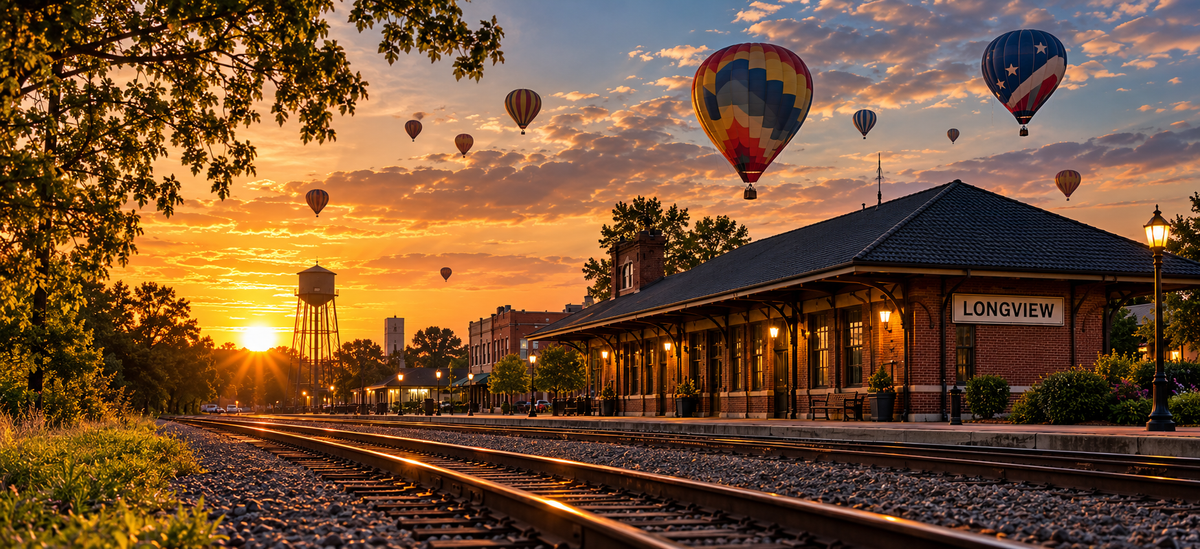
Completed in 1940, the surviving Texas & Pacific/Missouri Pacific depot replaced an earlier station dating to 1874. It contained waiting rooms, ticket and telegraph offices, baggage and express facilities, a mail room and other spaces required by a working passenger station. Today it is a Recorded Texas Historic Landmark.

Looking Up

Longview's transportation story eventually found another symbol in the sky.
The Great Texas Balloon Race began in 1978 as part of the celebration surrounding the opening of Longview Mall. It grew into a world-class competition that brings balloon pilots and visitors to Longview, with competition flights, special-shape balloons and the nighttime balloon glow becoming some of the city's most recognizable traditions.
In 2013, the 83rd Texas Legislature proclaimed Gregg County the Balloon Race Capital of Texas. Today, the event remains one of Longview's signature celebrations—a modern chapter in a city whose story has always been tied to movement, connection and looking toward the horizon.
Railroad tracks helped create Longview. More than a century later, colorful balloons above the Piney Woods have become another unmistakable image of home.
The View From Here
Longview's story began with a view across an East Texas landscape and a railroad pushing toward somewhere new.
More than 150 years later, the tracks, downtown streets and surviving depot still carry pieces of that beginning.
For us, that's what hometown heritage is about. Not simply remembering what a place used to be, but recognizing the pieces of its story that are still around us.
East Texas Roots. Everyday Stories.
ETX Stories explores the people, places and history that make East Texas home.
Sources & Further Reading
City of Longview — About Longview
City of Longview — Longview Train Depot
Texas State Historical Association — Longview
Texas State Historical Association — Longview Junction
Texas State Historical Association — Longview and Sabine Valley Railway
Visit Longview — Great Texas Balloon Race and Longview visitor information
KEEP EXPLORING EAST TEXAS
More ETX Stories
 TYLER
Why Tyler Is Called the Rose City
How roses became part of Tyler's identity and one of East Texas' best-known traditions.
 KILGORE
The World's Richest Acre
The oil boom, downtown derricks and the East Texas story that reshaped Kilgore.
 MARSHALL
Where the Rhythm Met the Rails
Railroads, music, education and the people who shaped Marshall's East Texas story.